 ContractorKeith
 update, august 2, 2026: this post captured the development build before i settled the public release. ködade is now open source under Apache 2.0, with no paid tier. KödWhisper, KödSSH, KödLocal, KödWeb, and the deeper KödPR work are still development surfaces, not features in the first public package.
i pay for three coding agents every month. Claude Code, Codex, and Grok, each with its own window and its own login. by 6am my desktop looked like a bid day with no folder system.
so i built ködade. two döts. one window.
what it is
ködade is a desktop ADE (agentic development environment) that runs the agent CLIs you already pay for instead of replacing them. it’s a Tauri 2 app, small and fast, and it never touches your billing: you log in to each CLI inside ködade’s terminals the same way you do in your own shell. no API keys through ködade, ever.
that last part is the whole philosophy. your subscriptions, your shell, your prompt, your PATH.
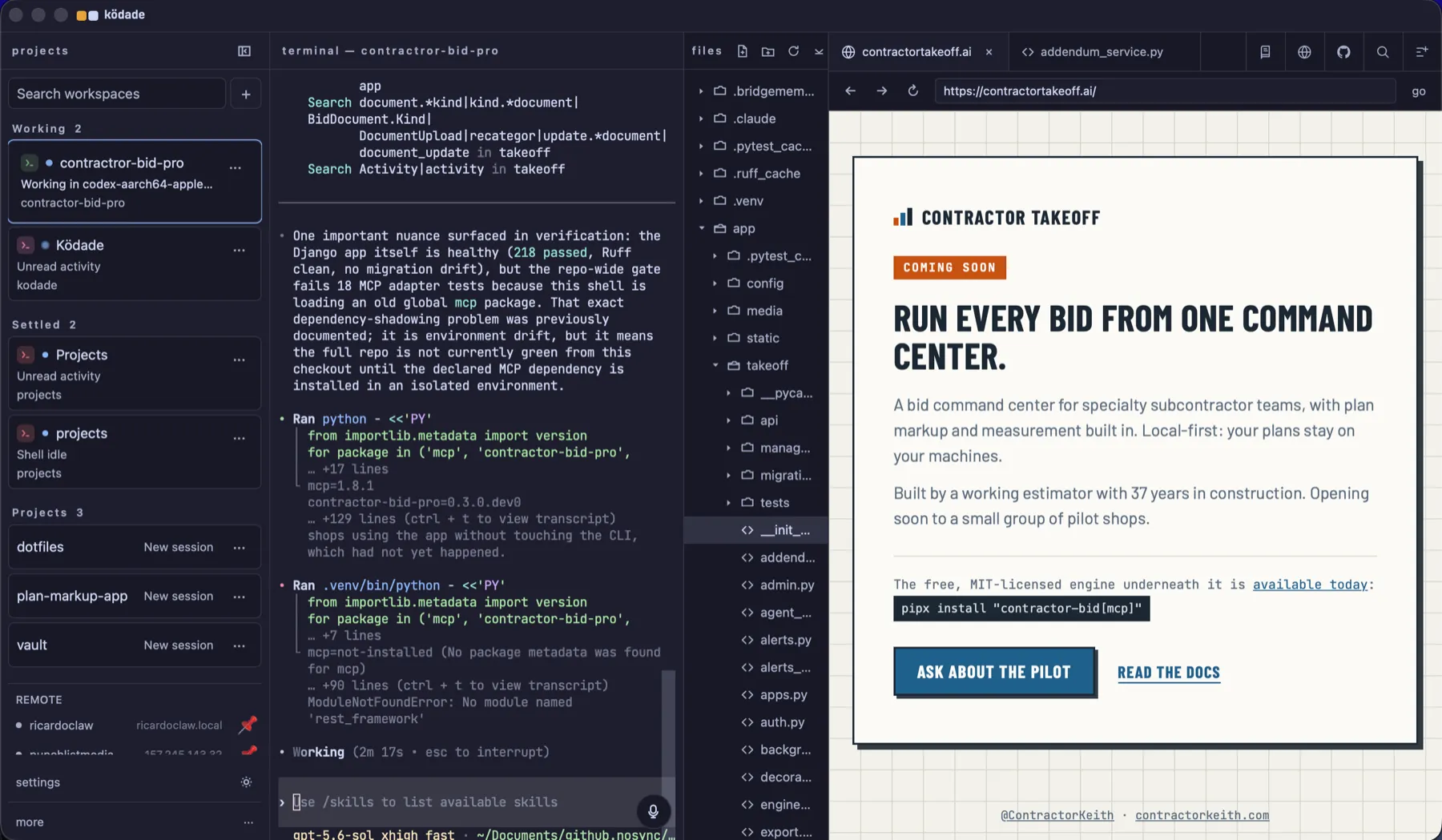
that’s my real setup, not a staged demo. Codex is working contractor-bid-pro in one workspace, two more are settled and waiting on me, and the built-in browser is open to another project’s landing page. the sidebar knows which sessions are working and which are done, so i stop babysitting terminals.
what works today
the core app shipped first and is at v1.3 now:
- workspaces: every project gets its own sessions in the sidebar, sorted into working, settled, and idle. glance, don’t dig.
- real terminals: each one spawns your actual login shell, so your powerlevel10k or starship prompt shows up exactly like home. one click launches Claude Code, Codex, Grok, OpenCode, or a local model in there.
- files and an editor: a live file tree next to a CodeMirror editor. the agents write most of the code; i read it and tweak.
- tabs and a built-in browser: file tabs, browser tabs, and a GitHub view that puts the repo’s issues and pull requests inside the app.
- themes: Catppuccin, Tokyo Night, and Atom One, dark and light each, with one token system driving the UI, the terminal, and the editor together.
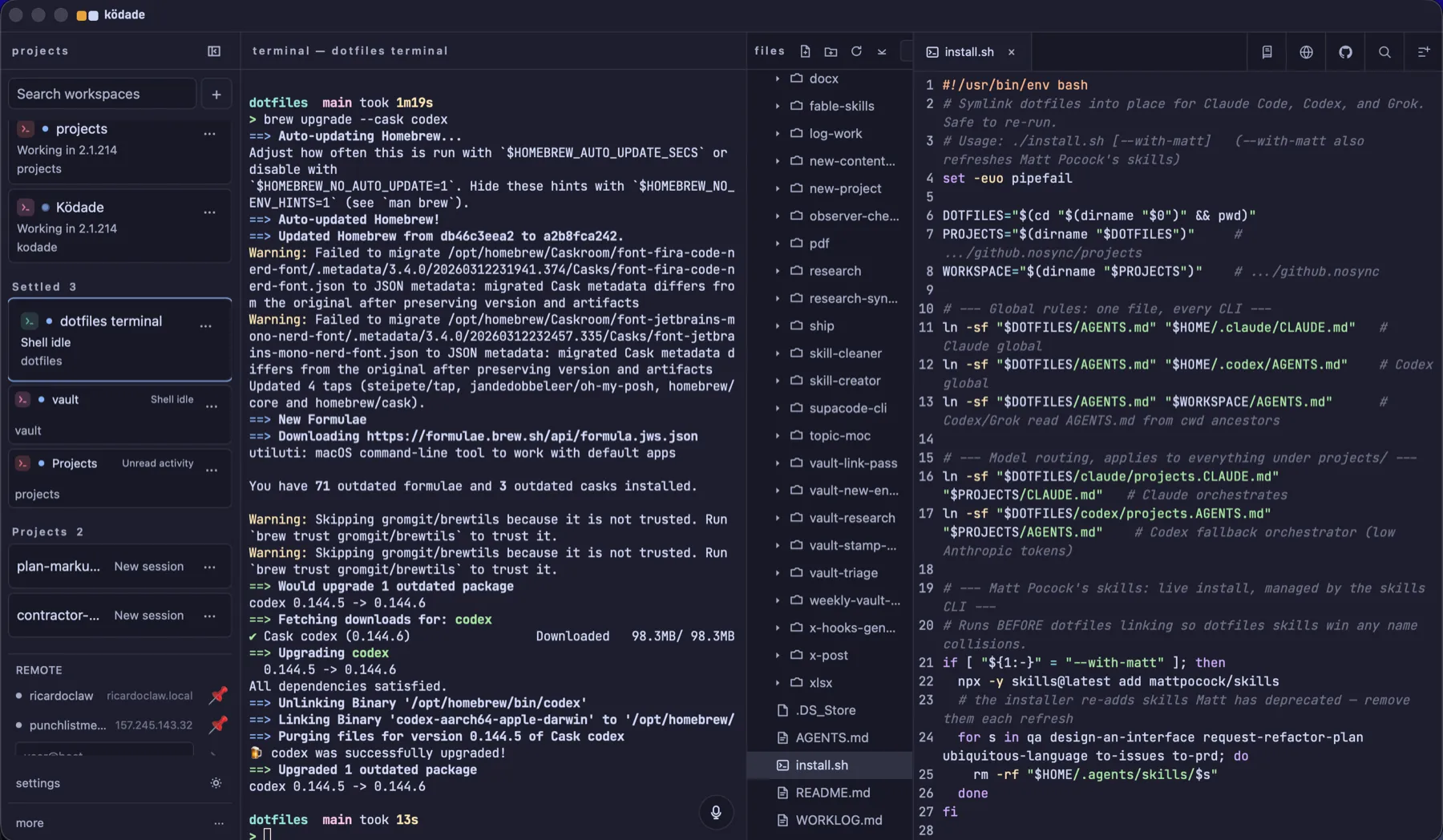
and it’s also just a good terminal. that screenshot is my dotfiles session doing a plain brew upgrade of codex, 0.144.5 to 0.144.6, with the install script open in the editor beside it. no agent involved.
then the Köd features started landing:
- KödWhisper: hold a key and talk. the transcript lands in the focused terminal, unsent, so you review before you fire. speech-to-text runs local on your machine, no cloud, and the smarter layer knows you’re prompting an agent in a repo, so “slash plan” comes out as /plan.
- KödHarness: a GUI for the stuff that decides what your agents actually know: the CLAUDE.md and AGENTS.md instruction files, skills, subagents, and MCP registrations, across every CLI and every project. open a project and see exactly what each agent reads before it runs, then manage it without hand-editing five config files.
- KödSSH: the hosts from your ~/.ssh/config show up in the sidebar. connect to the homelab box or a VPS, run agent CLIs there, pin remote projects. it rides your system’s own ssh binary and never sees a credential.
- KödPR: in-app diff and PR review. agent diffs run big, mine anyway, so review gives you a risk-ranked reading order instead of an alphabetical file list, and a line comment can turn into a fix prompt aimed back at the agent session that wrote the code.
- KödWeb: run kodade-serve on an always-on machine and drive ködade from a browser. close the laptop and nothing stops; reopen and it replays what you missed.
the test suite behind all of it sits a bit over 1,800 tests between TypeScript and Rust. that number matters to me more than the feature count.
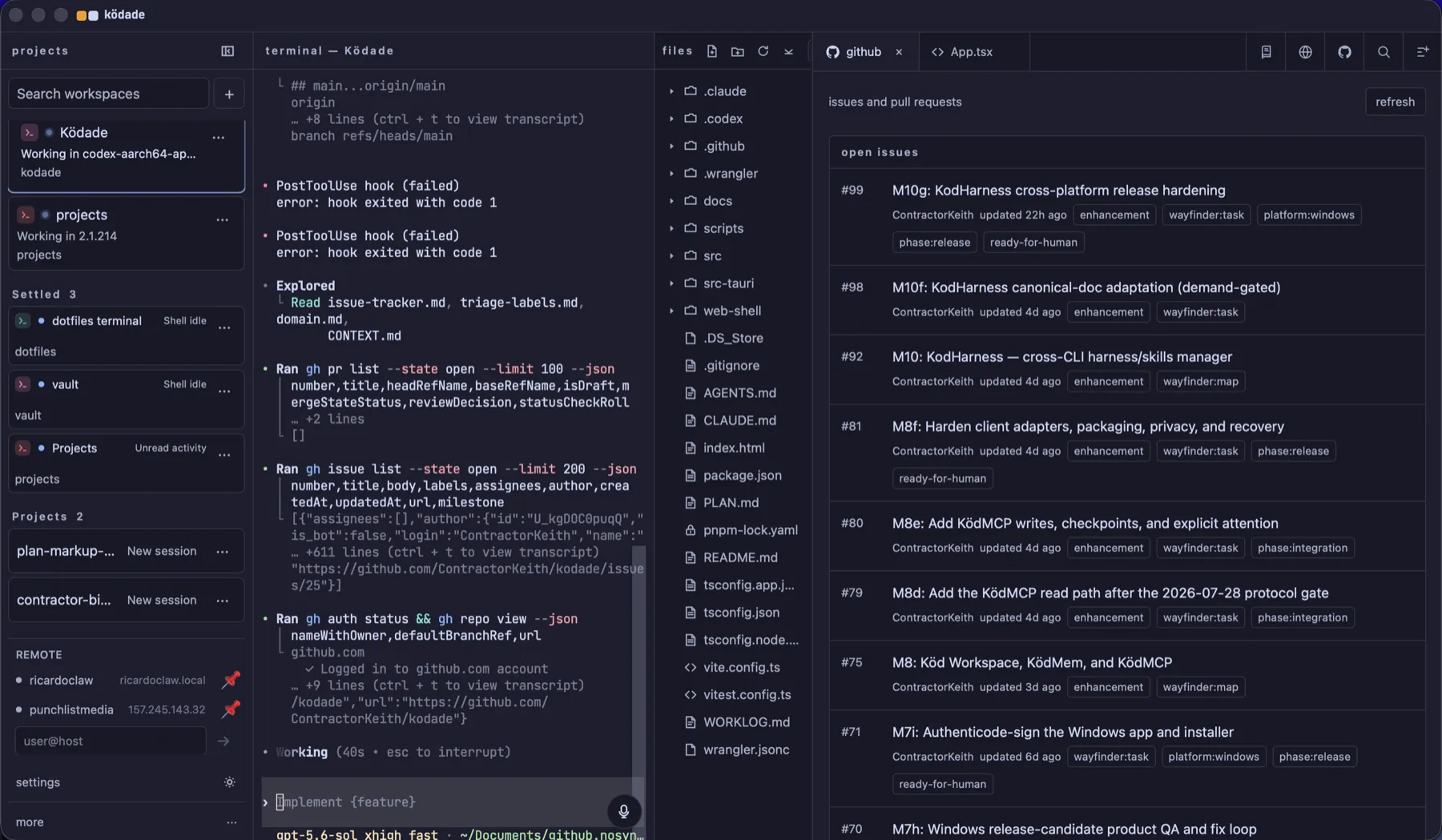
my favorite screenshot of the bunch, because that’s ködade building ködade. the GitHub tab is the app’s own issue tracker, and the milestones on screen are features from this post. two days ago an autonomous run in there merged 8 pull requests and deleted 43 dead branches without me touching the keyboard.
in flight right now
the next three features are really one system, and it’s what i’m building at the moment:
- Köd Workspace: the sidebar stops being a static project tree and starts tracking attention. what each session touched, what changed, what needs your eyes next.
- KödMem: local-first project memory. the useful parts of session activity become durable notes that live with the project, readable by you, not parked in somebody’s cloud.
- KödMCP: a local MCP server that serves that memory to any agent CLI. Claude Code picks up what Codex learned yesterday.
and the unglamorous work: the Windows build runs today, and what’s left is release hardening, signing, and QA before i hand builds out. same story for Mac notarization. shipping is a feature too.
further out
KödLocal is the one i’m most excited about. it turns models you’ve already downloaded (GGUF, MLX) into first-class ködade agents with an embedded inference engine. no Ollama, no LM Studio, no third runtime to babysit.
two ideas drive it. first, no ceiling: if your Mac Studio can hold a 200B model, ködade should run it, not funnel you into a 7B chat toy. second, local models are workers, because a frontier CLI like Claude Code should be able to hand a bounded subtask (private code, bulk context, zero marginal cost) to the model running on your own box.
that’s the future column. planned and spec’d, not built.
open source
that plan changed.
ködade is now Apache 2.0, with no paid feature tier and no required account. the first public macOS release is on GitHub, and the source that is open today stays open.
if paid work ever shows up around ködade, it will add a hosted service or support. it will not put a new lock around code already released to the community.
the docs live at kodade.com/docs, and they grow as each feature lands. if you run more than one agent CLI and you’re tired of the yard-sale desktop, you’re who i’m building this for.